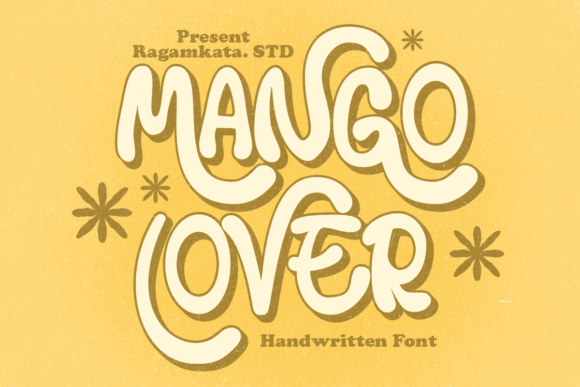
Evaluating Mango Lover: A Playful Script for Modern Branding
In the crowded landscape of digital typography, finding a display font that balances whimsy with professional usability is often a challenge. Many handwritten styles lean too heavily into illegibility or feel overly generic, lacking the specific character needed to make a brand stand out. Mango Lover emerges as a compelling option in this space, offering an organically handwritten sans serif aesthetic that manages to feel both personal and polished. For designers, marketers, and small business owners looking to inject a sense of approachable charm into their visual identity, understanding the nuances of this typeface is essential before integrating it into a workflow.
At its core, Mango Lover is defined by its "dancing" quality. Unlike rigid geometric sans serifs or formal scripts that demand strict baseline adherence, this font mimics the natural variation found in human handwriting. The letterforms possess a playful bounce, creating a rhythm that draws the eye across headlines and short blocks of text. This organic movement is not random; it is carefully constructed to maintain readability while avoiding the sterile perfection of machine-generated text. For projects requiring a human touch—such as artisanal product packaging, lifestyle blogs, or boutique service offerings—this characteristic provides an immediate emotional connection with the audience.
Technical Features and Customization Potential
Beyond its initial visual appeal, the practical value of Mango Lover lies in its technical construction. A significant strength of this typeface is its inclusion of a dedicated Shadow version. In typography, adding depth to flat text can be tricky without resorting to clumsy layer effects in design software. Having a pre-designed shadow variant ensures consistent stroke weight and alignment, allowing creators to add dimension to logos or headers instantly. This feature is particularly useful for creating retro-inspired badges or making text pop against busy backgrounds, saving time during the design process while maintaining high-quality vector integrity.
Furthermore, Mango Lover is PUA encoded (Private Use Area). For those less familiar with font engineering, this is a critical feature for creative flexibility. PUA encoding allows access to a vast array of alternate characters, ligatures, and glyphs directly through the character map or via simple keystroke combinations, depending on the software used. This means the font is not limited to a single static look. Designers can swap out standard letters for stylistic alternates to break up repetitive patterns, ensuring that no two words look exactly alike. This capability transforms the font from a simple typing tool into a creative playground, enabling the creation of unique logotypes where specific letter connections can be tailored for optimal flow.
Real-World Application and Performance
When evaluating how Mango Lover performs in real-world scenarios, its strengths are most evident in display settings. As a display font, it excels in headlines, posters, social media graphics, and packaging labels. The organic lines and playful spacing command attention without shouting, making it effective for brands that want to appear friendly and accessible rather than corporate or distant. For example, a coffee shop rebranding its cup sleeves or a freelancer designing a portfolio cover would find the font's personality aligns well with a narrative of craftsmanship and care.
However, professional objectivity requires acknowledging limitations. Like most decorative handwritten fonts, Mango Lover is not intended for long-form body copy. While the letterforms are distinct, the varying baselines and casual spacing can reduce reading speed and cause eye fatigue when used in paragraphs exceeding a few sentences. Its primary role should remain within the realm of accentuation and headline work. Users should plan their typographic hierarchy accordingly, pairing Mango Lover with a clean, neutral sans serif or a highly legible serif for body text to ensure overall project readability.
Who Benefits Most from This Typeface?
The utility of Mango Lover extends across various professional sectors, but it offers specific advantages to certain groups. Entrepreneurs and small business owners in the lifestyle, food, beauty, or education sectors will find it particularly valuable. These industries often rely on building trust through personality, and a font that feels hand-crafted can subtly communicate authenticity. Similarly, educators and content creators developing materials for younger audiences or informal workshops can leverage the font's playful nature to make information feel less intimidating and more engaging.
For freelance designers and agencies, the inclusion of ligatures and the shadow version adds efficiency to the toolkit. Instead of manually drawing shadows or hunting for alternate glyphs in complex OpenType menus, the PUA encoding streamlines the customization process. This reliability allows professionals to iterate quickly during client presentations, testing different stylistic variations of a logo or header in minutes rather than hours. The consistency of the shadow font, in particular, ensures that the final deliverable looks cohesive across different media, from digital screens to print merchandise.
Long-Term Value and Versatility
Investing in a typeface like Mango Lover is about more than just a single project; it is about acquiring a versatile asset that can adapt to evolving design trends. The trend toward "humanized" branding shows no sign of slowing down, as consumers increasingly seek genuine connections with the companies they support. A font that successfully mimics organic handwriting without sacrificing clarity positions itself as a long-term resource. The ability to toggle between the standard and shadow versions, combined with the extensive library of alternates, ensures that the font does not become stale. It can be refreshed simply by choosing different glyph combinations, extending its lifespan within a brand's visual identity system.
Moreover, the technical stability of PUA encoded fonts generally ensures better compatibility across different operating systems and design applications, reducing the risk of missing characters or formatting errors when files are shared between team members or sent to print vendors. This reliability is a crucial factor for professionals who cannot afford last-minute technical glitches before a launch.
Final Considerations for Implementation
Before downloading or purchasing Mango Lover, potential users should assess their specific project requirements. If the goal is to create a serious, authoritative financial report or a legal document, this font is likely unsuitable. However, for any initiative aiming to evoke warmth, creativity, and a touch of fun, it serves as an excellent choice. The key to maximizing its effectiveness lies in restraint and pairing. Using it sparingly for impact, supported by robust secondary typography, will yield the best results.
In summary, Mango Lover represents a well-constructed intersection of style and function. Its organic sans serif structure offers a fresh alternative to overused script fonts, while features like the shadow version and PUA encoding provide the technical depth required for professional work. For creators looking to infuse their projects with a distinctive, hand-made feel without compromising on quality or usability, this typeface warrants serious consideration. By understanding its strengths in display contexts and leveraging its customizability, designers can create memorable visual experiences that resonate with their target audiences.