Unlocking Depth and Dimension with Bubble Block Typography
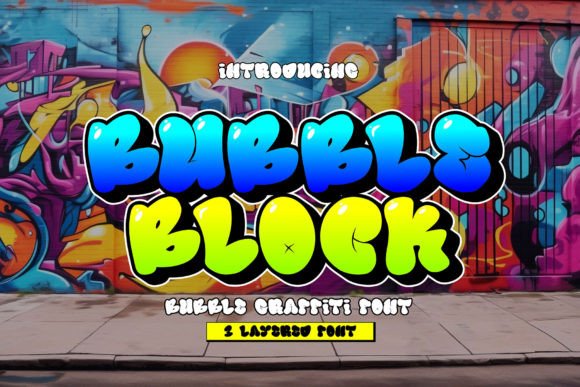
There is a specific kind of visual weight that only a true 3D typeface can deliver. In a digital landscape often flattened by minimalism and thin sans-serifs, Bubble Block arrives as a bold counter-statement. This isn't just a font; it is a comprehensive typographic system designed to mimic the layered complexity of street art graffiti. By encompassing solid, shadow, and inner shadow styles within a single family, it offers designers the rare ability to construct text that physically pops off the screen or page without needing complex vector manipulation in Illustrator or Photoshop.
For creatives aged 20 to 50 who are constantly balancing aesthetic trends with practical deadlines, the appeal of Bubble Block lies in its efficiency. It solves the age-old problem of making text "look expensive" or "hand-crafted" without requiring hours of manual layering. Whether you are a seasoned graphic designer, a small business owner creating your own marketing materials, or a content creator looking to spice up social media graphics, understanding how to leverage this 3D layered tool can transform ordinary headlines into commanding visual assets.
The Mechanics of Instant Depth
At its core, Bubble Block functions by providing three distinct but coordinated layers: the solid face, the drop shadow, and the inner shadow. In traditional design workflows, achieving a convincing 3D effect often involves duplicating text layers, offsetting them pixel by pixel, and manually coloring them to simulate light sources. It is a tedious process that can easily look amateurish if the lighting logic isn't consistent.
This font bypasses that friction. When you apply the solid style, you get the primary color of your letterform. Activate the shadow layer, and suddenly the text has grounding and distance from the background. Engage the inner shadow, and the letters gain volume, appearing inflated or carved rather than flat. This triad of styles allows for a dynamic range of appearances. You aren't stuck with one look; you can mix and match these layers to suit the mood of the project. Need something playful and bouncy? Crank up the inner shadow for a balloon-like effect. Need something gritty and urban? Rely heavily on the hard edges of the drop shadow to create a stencil-like presence.
Real-World Applications Across Industries
The versatility of Bubble Block means it finds a home in vastly different sectors. Its utility goes far beyond simple decoration; it serves as a functional tool for hierarchy and attention management.
Streetwear and Urban Fashion Branding
In the world of streetwear, authenticity is currency. Brands targeting the youth market often rely on graffiti aesthetics to signal cultural relevance. Bubble Block is perfectly suited for t-shirt graphics, hoodie prints, and lookbook covers. Because the font inherently carries the DNA of spray-painted art, it lends an immediate "street cred" to a brand identity. A clothing startup can use the solid layer for the main logo and the shadow layer to create a sticker effect on packaging, ensuring consistency across physical and digital touchpoints without hiring a specialized lettering artist.
Event Promotion and Nightlife
Consider the fast-paced environment of event promotion. Flyers for music festivals, club nights, or underground rap battles need to grab attention in a split second while scrolling through Instagram or pinned to a community board. The high-contrast nature of Bubble Block ensures readability even at smaller sizes or against busy backgrounds. Promoters can use the 3D effect to make date and time information stand out aggressively. The layered style allows for creative color combinations—neon pinks against deep purples, or electric blues against black—that resonate with the energy of nightlife culture.
Gaming and Esports Overlays
The gaming industry thrives on hyper-stylized visuals. Streamers and esports organizations constantly need assets that feel energetic and competitive. Bubble Block works exceptionally well for stream overlays, tournament brackets, and thumbnail text. The dimensional quality of the font mimics the UI elements found in many modern video games, creating a familiar and engaging experience for viewers. A streamer might use the inner shadow style to create a "pressed button" look for alert notifications, adding a tactile feel to their broadcast graphics.
Retro and Y2K Marketing Campaigns
Nostalgia is a powerful marketing driver. As design trends cycle back to the late 90s and early 2000s, there is a renewed hunger for the bubbly, inflated typography that defined that era. Marketing agencies working on retro-themed campaigns for beverages, snacks, or tech products can utilize Bubble Block to instantly evoke that specific timeframe. It saves the design team from hunting down vintage references or trying to recreate old-school effects from scratch. The font does the heavy lifting, allowing the campaign to focus on messaging while the typography handles the vibe.
Strategic Considerations for Implementation
While the capabilities of Bubble Block are impressive, effective usage requires a degree of restraint and strategic thinking. Just because you can add three layers of depth doesn't mean you always should.
- Context is King: This font demands space. It is not suitable for body copy or dense paragraphs. Its strength lies in headlines, logos, and short call-to-action phrases. Using it for long-form text will fatigue the reader's eye and reduce legibility.
- Background Contrast: The 3D effect relies heavily on the relationship between the text and the background. The shadow layers can get lost if placed over a busy or dark image that matches the shadow color. Always test your composition on various backgrounds to ensure the depth remains visible.
- Color Theory: With three layers available, the color palette possibilities are endless, but they can also become chaotic. A common mistake is using too many competing colors. Stick to a cohesive scheme where the solid, shadow, and inner shadow complement each other rather than clash. Sometimes, a monochromatic approach (different shades of the same hue) yields the most sophisticated 3D result.
- Scalability: While great for posters and screens, consider how the font translates to very small scales, such as mobile app icons or favicon sizes. The intricate details of the inner shadow might blur when scaled down too far. In these cases, relying primarily on the solid layer might be the pragmatic choice.
Balancing Strengths and Limitations
The primary strength of Bubble Block is its ability to democratize high-end typographic effects. It lowers the barrier to entry for non-designers while offering enough nuance for professionals to tweak and refine. It creates an immediate emotional response—fun, bold, loud—which is exactly what many modern brands crave.
However, its stylistic specificity is also its limitation. It is not a neutral workhorse like Helvetica or Arial. You cannot use it for a corporate legal document or a minimalist luxury jewelry catalog without creating a dissonant brand message. It screams rather than whispers. Therefore, the decision to use Bubble Block should be driven by the personality of the brand or the specific goal of the piece. If the objective is to blend in, look elsewhere. If the objective is to stand out, disrupt, and engage, this layered graffiti font provides the perfect toolkit.
Ultimately, integrating Bubble Block into your creative workflow is about recognizing when a project needs that extra dimension. It is a resource that turns flat ideas into tangible, popping realities, bridging the gap between digital design and the physical texture of street art. By understanding its layers and respecting its bold nature, you can unlock a new level of visual impact in your work.